FSI benchmark: highly flexible plate in axial flow
Dr Mohammad Ghaffari · 2020 to 2024 · Research
Context
A thin plate held at its leading edge in a uniform flow will flap like a flag. At very low bending rigidity, the plate bends into large, fast-changing shapes, and the flow and structure interact strongly over the whole cycle. Many FSI solvers lose accuracy or stability in this range, so it is a demanding test for flexible-structure work.
My role
I was the CFD engineer who developed the coupled solver and ran the validation.
Approach
- Same coupled lattice Boltzmann, finite element and immersed-boundary solver as above.
- Plate of length L fixed at its leading edge, in a 16L × 6L domain, at Re = 100 with stretching coefficient 500.
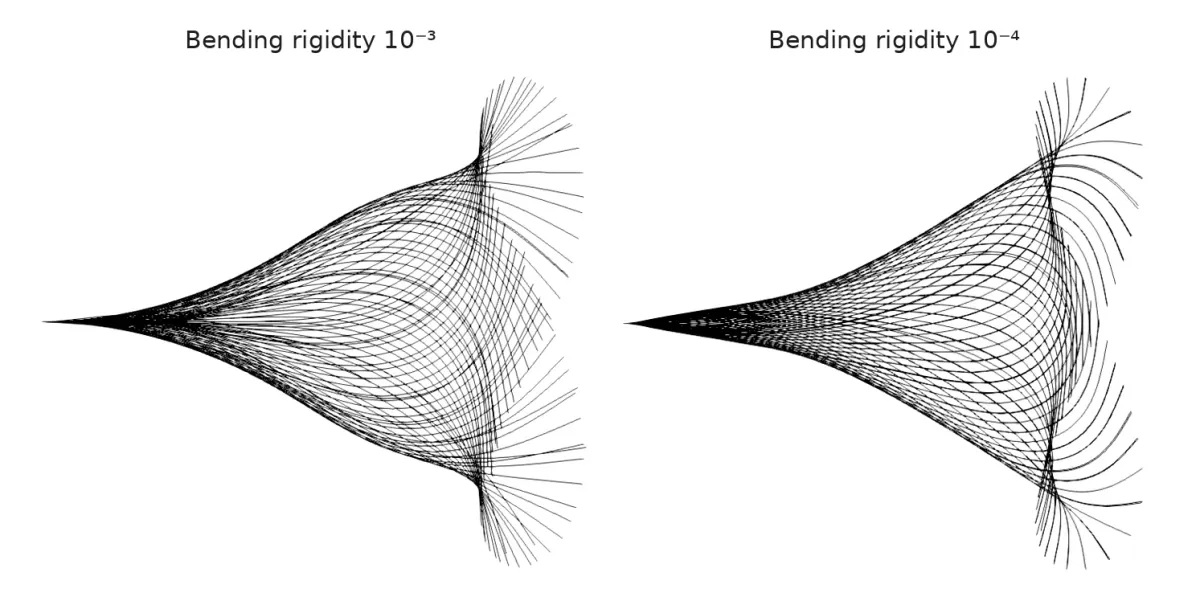
- Two bending rigidities, 10⁻³ and 10⁻⁴; the second is the very flexible case.
- Mesh-independence check at three grid levels (Δx/L = 0.025, 0.0125 and 0.00625), with each run carried through to a periodic state.
Figures
Outcome
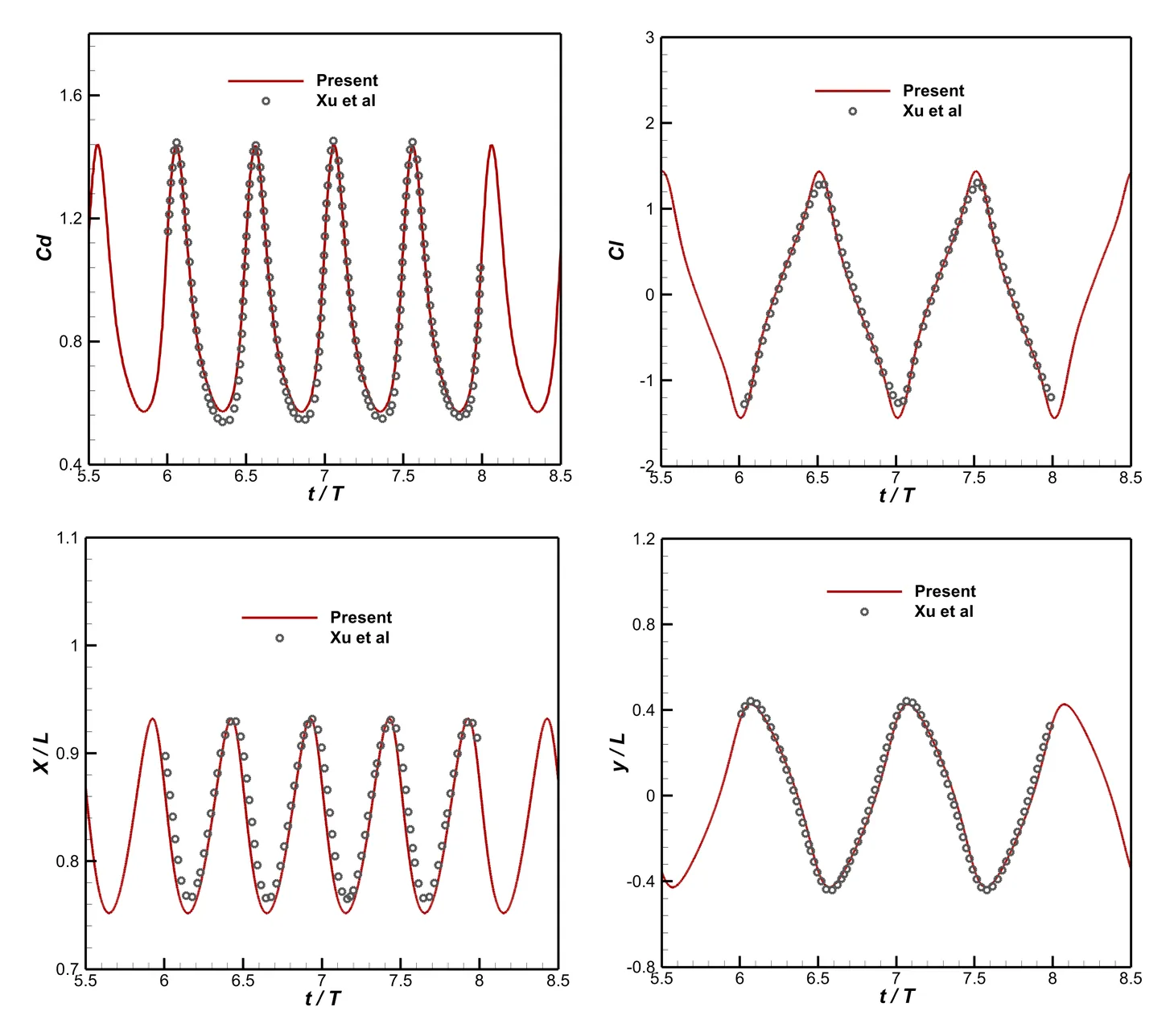
- Bending rigidity 10⁻³: mean drag coefficient 0.857, flapping amplitude 0.858 and Strouhal number 0.301, against 0.878, 0.886 and 0.299 in Xu et al. (2018).
- Bending rigidity 10⁻⁴: mean drag coefficient 0.951 and Strouhal number 0.320, against 0.948 and 0.309.
- Drag, lift and tip displacement follow the reference through the cycle, and the plate shapes match the published deformation patterns.
- Fluid structure interaction
- Flexible structures
- IB-LBM
- Validation