FSI benchmark: elastic beam behind a cylinder
Dr Mohammad Ghaffari · 2020 to 2024 · Research
Context
The Turek–Hron benchmark is the standard test for fluid–structure interaction codes. An elastic beam attached to the back of a cylinder is driven into large, self-sustained oscillation by vortex shedding. The beam's motion and the flow have to be solved together, and the result is sensitive to how the fluid and structure are coupled. A solver that gets this case right can be trusted on real FSI problems.
My role
I was the CFD engineer who developed the coupled solver and ran the validation.
Approach
- Coupled solver: lattice Boltzmann for the fluid, finite elements for the large-deformation structure, and immersed-boundary coupling between them, in parallel C++.
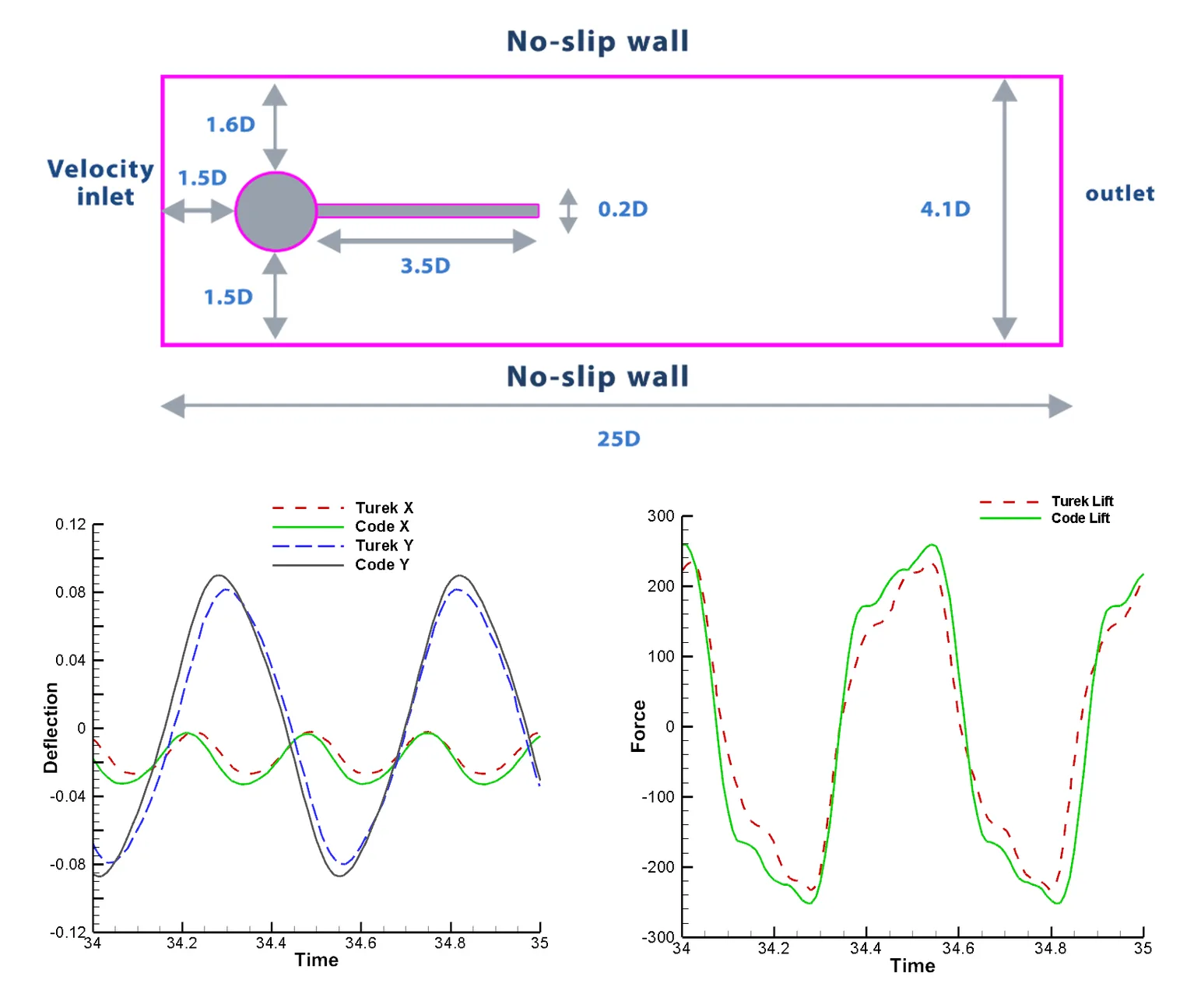
- Beam of length 3.5D and thickness 0.2D behind a cylinder of diameter D, in a 25D × 4.1D channel, at Re = 100.
- Two solid-to-fluid density ratios: 10, and 1. The second is the harder case, because light structures make the coupling less stable.
- Mesh-independence check at three grid levels (Δx/D = 0.05, 0.025 and 0.0125).
Figures
Outcome
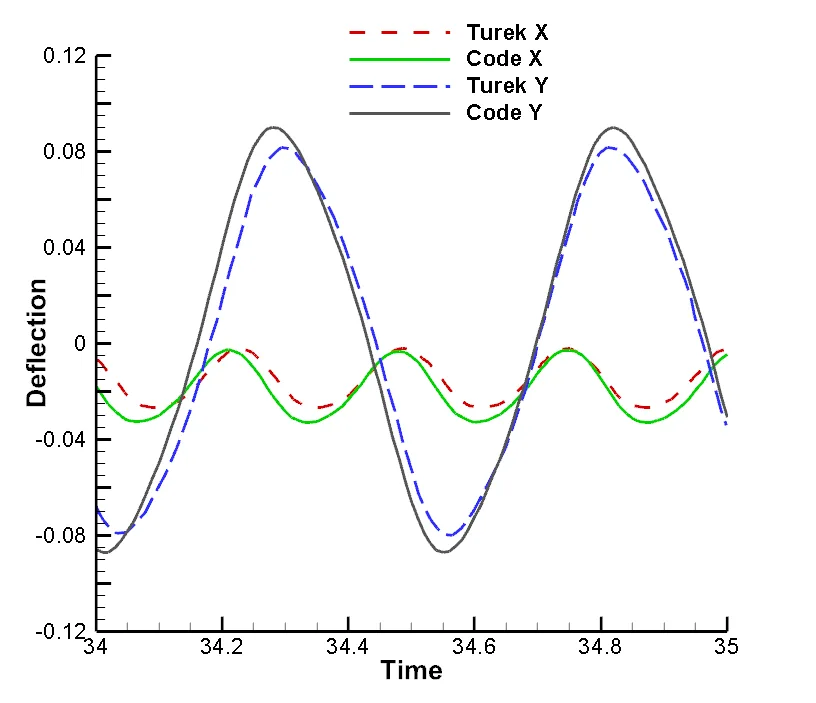
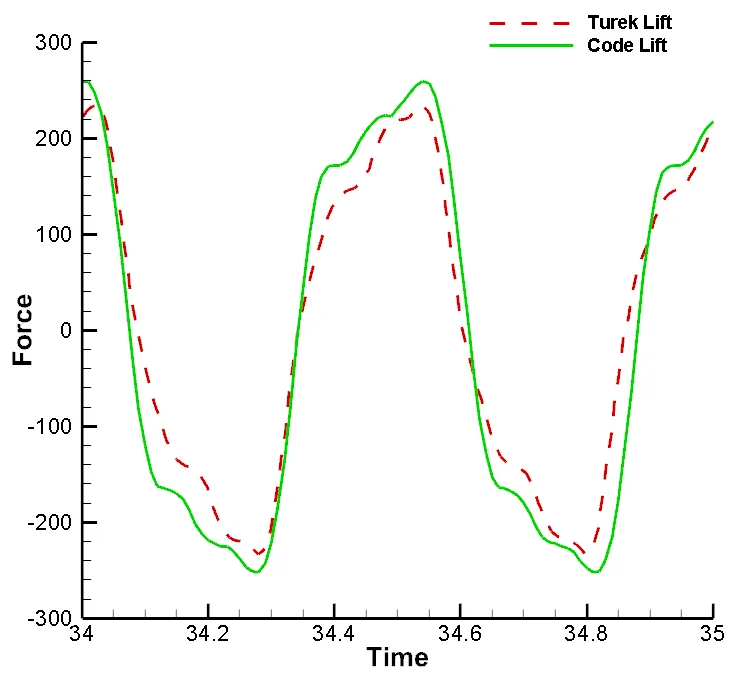
- Density ratio 10: tip-motion Strouhal numbers of 0.374 (streamwise) and 0.185 (transverse), against 0.384 and 0.192 in the Turek & Hron benchmark. Tip deflection and lift force follow the reference closely over the full cycle.
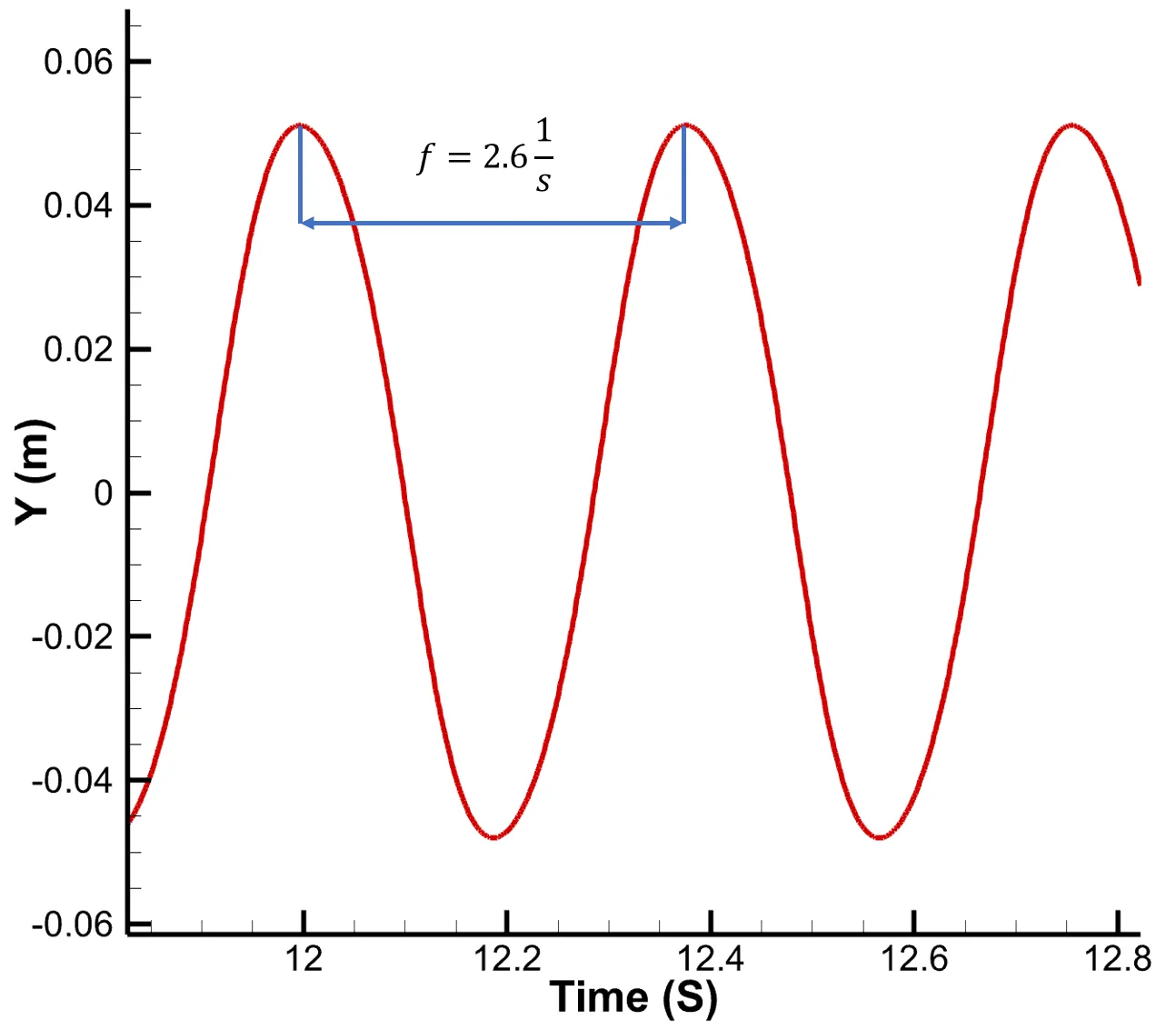
- Density ratio 1: mean drag coefficient of 2.38 and Strouhal number of 0.26, within the range of published results (mean drag 2.16–2.30, Strouhal 0.26–0.29).
- The solver handles both heavy and light structures without loss of stability.
- Fluid structure interaction
- Turek–Hron benchmark
- IB-LBM
- Validation