Skip to content

Work & Projects

Selected work.

A selection of professional projects, research and independent builds across fire safety engineering, computational mechanics and numerical methods.

Selected projects

Hyperscale data centre campus

Context

Hyperscale data centres concentrate enormous electrical loads, dense distribution, and business-critical uptime inside very large fire compartments, a combination the prescriptive code was never written for. The fire strategy has to protect life safety without compromising the operational requirements that make the facility viable.

My role

I was the fire safety engineer on the project team, developing the fire engineering strategy, assessing departures from Deemed-to-Satisfy provisions, and coordinating fire safety requirements across the design team.

Approach

  • Performance-based assessment of large-compartment and egress departures under the NCC.
  • Fire and smoke modelling to test tenability under the design fire scenarios.
  • Fire safety strategy for high-hazard spaces: battery and UPS rooms, generators, fuel storage.
  • Coordination with services and structural design, and with the certification and authority pathway.

Outcome

A fire engineering strategy that supports the compliance pathway while preserving the operational design intent of the facility.

  • NCC performance solutions
  • FDS
  • Tenability assessment
  • DtS departure analysis

Commercial project. Details generalised.
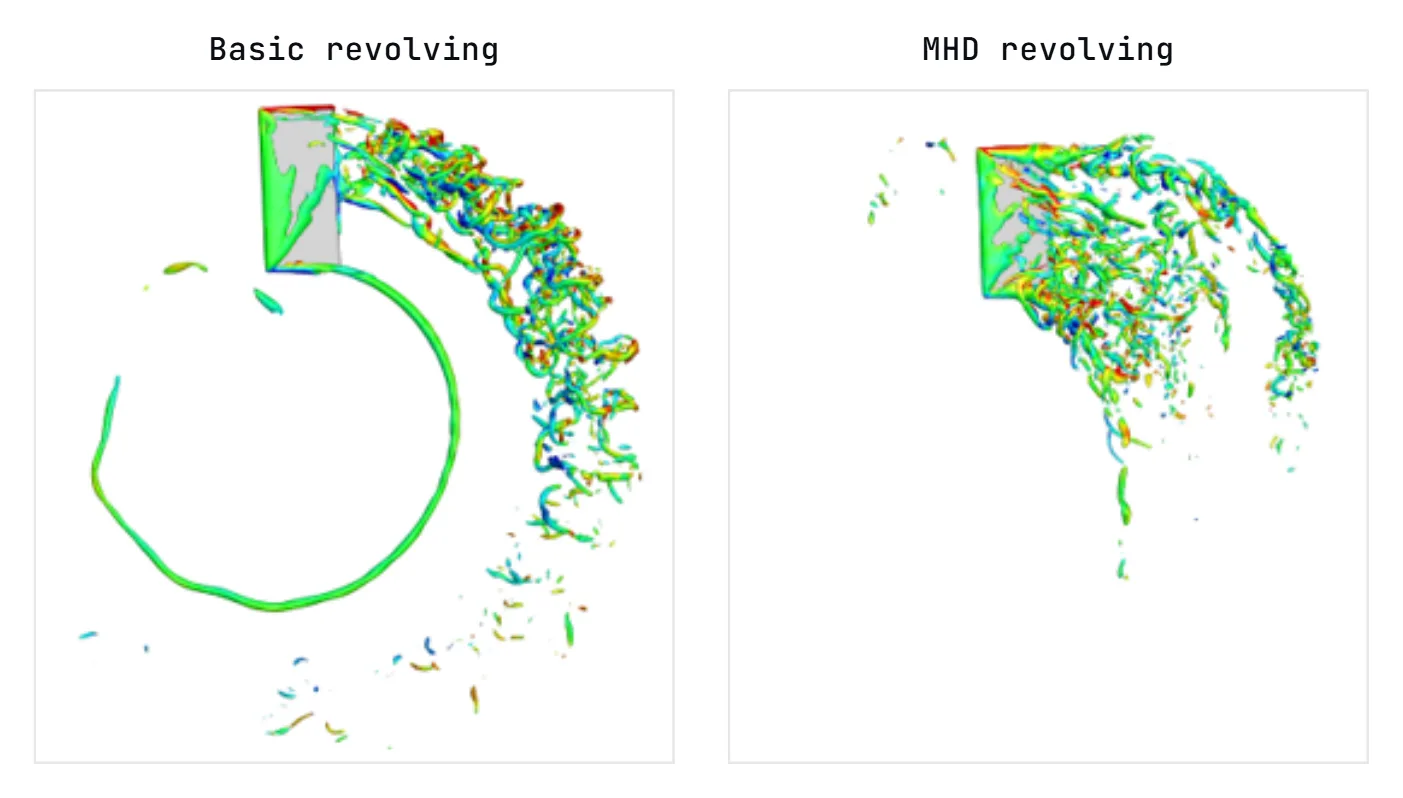
Vorticity field around the aerofoil and flaps. Own simulation.

Bio-inspired flaps on an aerofoil

Context

Birds adapt the flow over their wings with feathers that lift, bend and realign as conditions change. The aerodynamic role of that behaviour is not well understood, partly because modelling very light, very flexible structures inside a turbulent flow is difficult.

My role

I was the CFD engineer building the coupled solver and running the study across the parameter space.

Approach

  • Modelled feather-like flaps attached to an aerofoil as a fully coupled fluid structure interaction problem.
  • Varied mass ratio, bending rigidity, flap geometry and the number of flaps across the parameter space.
  • Resolved the flow with the lattice Boltzmann method and the structural response with finite elements, coupled through an immersed boundary method.

Outcome

The flaps improved the lift to drag ratio by up to 27.2 per cent compared with a clean aerofoil, through delayed flow separation, altered vortex shedding and stronger shear layer interaction.

  • IB-LBM
  • Fluid structure interaction
  • Flexible structures
  • Vortex dynamics

Premium-grade commercial tower

Context

Modern workplace design pushes toward open interconnection, generous lobbies, and transparency, all of which sit in tension with prescriptive compartmentation and egress rules. On a premium CBD tower, the fire strategy has to enable the architecture rather than fight it.

My role

I was the fire safety engineer preparing the fire engineering assessment and supporting the design team through design development.

Approach

  • Alternative solutions for interconnected floors and egress arrangements.
  • Smoke hazard management assessment for large-volume spaces.
  • Evacuation modelling to verify occupant egress performance.
  • Consultation with the certifier and fire brigade through the approval pathway.

Outcome

Fire engineering deliverables that carry the architectural intent through the compliance process.

  • NCC performance solutions
  • Pathfinder
  • Smoke hazard management
  • FER

Commercial project. Details generalised.
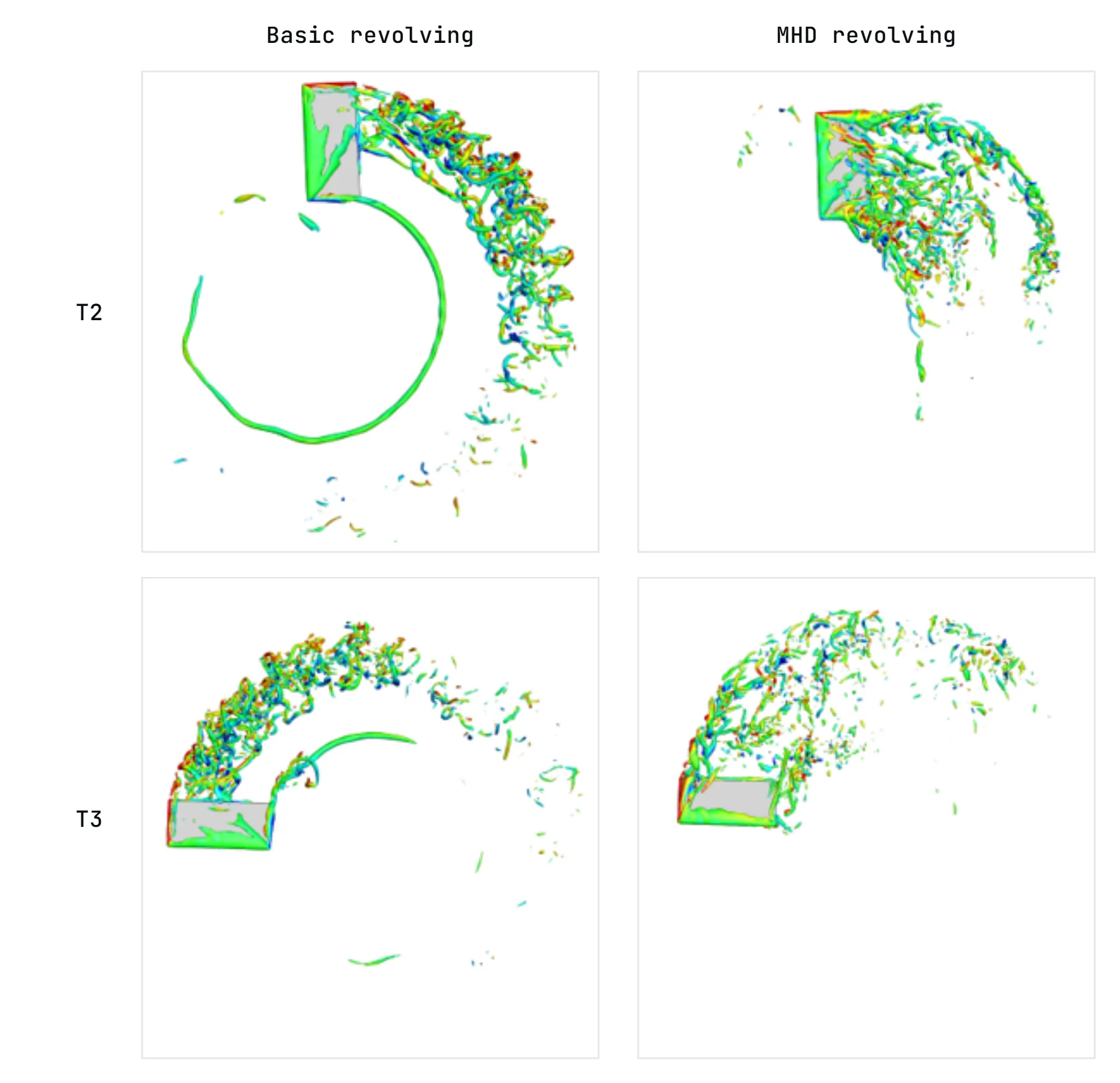
Vortex structures at one time instance, with and without magnetohydrodynamic forcing.
Vortex structures at one time instance, with and without magnetohydrodynamic forcing. Own simulation.

Magnetohydrodynamic control of revolving wings

Context

Revolving wings generate lift through a leading edge vortex that becomes unstable as it grows and breaks down. Stabilising that vortex directly improves the performance of small rotors and flapping wing vehicles.

My role

I was the CFD engineer extending the solver with magnetohydrodynamic forcing and running the simulation campaign.

Approach

  • Applied magnetohydrodynamic body forces to wings in revolving motion and in combined revolving and pitching motion.
  • Varied magnetic field strength, wing aspect ratio and angle of attack.
  • Examined the three dimensional vortex structures and the resulting force histories.

Figures

Flow structures visualised with the Q criterion, coloured by vorticity, at two time instances for the baseline and magnetohydrodynamic cases.
Flow structures visualised with the Q criterion, coloured by vorticity, at two time instances for the baseline and magnetohydrodynamic cases. Own simulation.

Outcome

The lift to drag ratio improved by up to 18 per cent for basic revolving wings and up to 32 per cent at low aspect ratio, with leading edge vortices staying coherent across a range of pitch angles.

  • Magnetohydrodynamics
  • Lorentz force
  • Revolving wings
  • Vortex stability

Advanced manufacturing research facility

Context

Advanced manufacturing facilities combine a manufacturing hall, laboratories, offices, loading docks and dangerous goods storage inside one envelope. Each function brings its own hazards and code pathway, and the interfaces between them carry most of the fire engineering difficulty.

My role

I was the fire safety engineer preparing substantial sections of the Fire Engineering Report and coordinating it through internal technical review.

Approach

  • Fire engineering provisions for the complex interfaces: fire shutters, compartmentation, façade details and smoke control.
  • Assessment of manufacturing hall and dangerous goods hazards within the performance framework.
  • Drawing review, mark-ups and information requests coordinated with the architect and wider design team.
  • Document-wide alignment checks between the project description, fire strategy and Performance Solutions.

Outcome

A coordinated Fire Engineering Report covering every function of the facility and the interfaces between them.

  • FER
  • Performance Solutions
  • Smoke control

Commercial project. Details generalised.
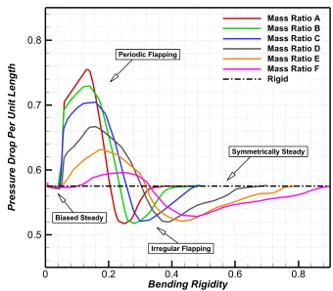
Pressure drop against bending rigidity, showing the four interaction regimes.
Pressure drop against bending rigidity, showing the four interaction regimes. Own simulation.

Unsteady flow through flexible porous media

Context

Classical porous media models assume a rigid matrix. Many real systems, from vegetation to filtration media and biological tissue, are built from light flexible elements that deform under the very flow they resist.

My role

I was the CFD engineer designing the simulation campaign and carrying out the regime analysis.

Approach

  • Represented the porous medium as arrays of cylinders with flexible flaps attached to the aft section.
  • Swept mass ratio, bending rigidity and porosity to map the fluid porous structure interaction.
  • Tracked pressure drop, structural response and energy dissipation across the parameter space.

Outcome

Four distinct regimes emerged: biased steady, periodic flapping, irregular flapping and symmetrically steady. Lighter and more flexible elements raised flow obstruction and pressure drop at low bending rigidity, while heavier flaps gave more stable but less dynamic behaviour.

  • IB-LBM
  • Fluid porous structure interaction
  • Porosity
  • Pressure drop

University tower façade replacement

Context

Combustible façade remediation is one of the defining fire safety programmes of the post-Grenfell era. Replacing the façade of an occupied high-rise campus building means getting the fire performance of the new system right, and managing the building’s safety through every stage of the works.

My role

I was the fire safety engineer providing input to the replacement façade design and its compliance pathway, including assessment of existing conditions.

Approach

  • Review of the fire performance of proposed façade systems and their test evidence.
  • Assessment of the compliance pathway for the replacement design.
  • Fire safety considerations for staging works on an occupied building.
  • Coordination with the design team and certifier through the approval process.

Outcome

A remediation design with a defensible fire-performance basis, and a building that stayed safely occupied throughout.

  • Façade fire performance
  • AS 5113 test evidence
  • Cladding remediation
  • Staged works

Commercial project. Details generalised.

Battery energy storage systems

Context

Grid-scale battery storage is being built faster than the codes that govern it. Thermal runaway, flammable gas generation, and deflagration risk sit outside conventional building fire safety. The engineering has to reach directly for the physics and the emerging international guidance.

My role

I was the fire safety engineer preparing fire risk and consequence assessments supporting development approvals for BESS facilities.

Approach

  • Consequence modelling of thermal-runaway scenarios and their effects on exposures.
  • Assessment of separation distances to site boundaries and adjacent hazards.
  • Review of deflagration venting and gas management provisions.
  • Benchmarking against emerging guidance, including NFPA 855 and manufacturer test data.

Outcome

Hazard assessments that gave consent authorities a defensible technical basis to approve new storage capacity.

  • Consequence modelling
  • NFPA 855
  • Thermal runaway
  • Development approvals

Commercial project. Details generalised.

Turbulent adjoint optimisation framework

Context

For industrial thermal equipment, the performance gains left on the table are geometric, but exploring geometry by trial-and-error simulation is hopeless. Adjoint methods invert the problem: one extra solve yields the sensitivity of performance to every point on the surface at once.

My role

I was the CFD engineer developing the adjoint capability within a proprietary CFD solver and applying it to client equipment.

Approach

  • Development of the 3-D adjoint solver for turbulent flow.
  • Integration with the in-house proprietary CFD code.
  • Surface-sensitivity-driven geometry improvement of heat exchangers and thermal equipment.
  • Validation of optimised designs against baseline performance.

Outcome

An in-house optimisation capability that turned geometry improvement from guesswork into a directed, repeatable process.

  • Adjoint methods
  • Turbulence modelling
  • Solver development
  • Heat exchangers

Commercial project. Details generalised.

Operational data centre battery upgrade

Context

Lithium-ion batteries inside an operational data centre concentrate a modern hazard in a building that cannot pause. Risk reduction has to be phased around live operations, mixed battery generations and systems that were designed before the hazard existed.

My role

I was the fire safety engineer supporting the fire strategy and management guidance for the battery installations and their phased upgrade.

Approach

  • Management and use framework setting out phased battery upgrades, risk controls and ongoing facilities management actions.
  • Review of battery hazards against ventilation, gas detection and smoke exhaust provisions and the existing fire engineering documentation.
  • Technical coordination across UL-tested and non-UL-tested battery arrangements, with departures and management actions documented.

Outcome

A phased, workable pathway that reduces battery risk while the facility keeps operating.

  • Risk assessment
  • Battery hazards
  • Management planning

Commercial project. Details generalised.

Landmark performing-arts venue

Context

A landmark performing-arts venue operating continuously under heritage constraints, with decades of layered fire safety systems. The annual fire safety statement here is not paperwork. It is a genuine engineering audit of how every essential measure actually performs.

My role

I was the fire safety engineer assessing essential fire safety measures for annual certification: site verification, performance review, and remediation advice.

Approach

  • Site verification of essential fire safety measures across the venue.
  • Review of the performance standards each installed measure must meet.
  • Identification of gaps and prioritised, practical remediation advice.
  • Coordination with facilities management around a continuously operating venue.

Outcome

A defensible annual assessment that keeps a nationally significant building certified and safe without interrupting its operation.

  • Essential fire safety measures
  • AFSS
  • Site inspection
  • Heritage constraints

Commercial project. Details generalised.

Immersed boundary lattice Boltzmann solver

Context

High fidelity simulation of flexible bodies in turbulent flow needs a solver that stays accurate and stable when the structure is very light, very flexible and free to move a long way. Off the shelf tools struggle with that combination.

My role

I was the CFD engineer building the solver from the mathematical formulation through to a validated, parallel implementation.

Approach

  • Lattice Boltzmann formulation for the fluid, chosen for its efficiency in transitional and turbulent regimes at Reynolds numbers from 1,000 to 10,000.
  • Finite element treatment of the structural response for large deformation of light, flexible bodies.
  • Immersed boundary coupling between the fluid and solid domains, with heat transfer included.
  • Validation against benchmark cases: flow past a two dimensional cylinder and three dimensional spheres, a hanging filament, flow induced vibration of an elastic beam behind a cylinder, and a highly flexible plate in axial flow.

Outcome

A validated research solver that underpins three separate studies and the publications that came from them.

  • LBM
  • Immersed boundary
  • Finite element
  • GPU parallelisation
  • Validation

CBD substation building

Context

A live substation inside a city redevelopment precinct keeps critical electrical infrastructure running while everything around it changes. The building carried non-compliant exit geometry, and Performance Solutions that leaned on systems and procedures the asset owner needed removed.

My role

I was the fire safety engineer developing the performance-based design brief and Fire Engineering Report for the building.

Approach

  • Performance Solutions reworked to remove reliance on the transformer deluge system, gas suppression, staff training and on-site fire wardens.
  • Assessment of non-compliant clear width and clear height at the modified exit, with updated evacuation strategies and egress drawings.
  • Stakeholder comment rounds across the asset owner, developer and design team, and lodgement through the fire brigade consultation pathway.

Outcome

An approved egress and fire safety basis for the building that stands without the systems the owner needed retired.

  • PBDB
  • Egress assessment
  • FRNSW consultation

Commercial project. Details generalised.

Rail stations compartmentation programme

Context

Rail stations accumulate decades of modifications: services punched through walls, doors replaced, fire-rated construction quietly compromised. Assessing compartmentation integrity across a portfolio of stations, while they remain fully operational, is as much a logistics problem as an engineering one.

My role

I was the fire safety engineer carrying out survey-based verification of fire compartmentation and reporting prioritised findings to the asset owner.

Approach

  • Systematic site surveys of fire-rated construction, doors, and service penetrations.
  • Assessment of compartmentation against the applicable performance requirements.
  • Prioritised remediation recommendations proportionate to risk.
  • Clear reporting formats an asset owner can act on across many sites.

Outcome

A portfolio-wide picture of compartmentation integrity, with remediation priorities the owner can schedule and budget.

  • Fire compartmentation
  • Site survey
  • Passive fire protection
  • Risk prioritisation

Commercial project. Details generalised.

Research

Published work.

A decade of academic work in computational mechanics: building the numerical methods and solvers that underpin high fidelity simulation, and publishing them at research depth. The same foundation that carries the industry work.

Journal articles

  1. [01]

    Constrained adjoint-based shape optimization for aerodynamic design on unstructured grids

    Ghaffari, M., Pasandideh, M., Tavakoli, A. · 2018

    Journal of Mechanical Engineering, University of Tabriz · 48(1), pp. 223-232

  2. [02]

    Numerical investigation of dimple effects on darrieus vertical axis wind turbine

    Sobhani, E., Ghaffari, M., Maghrebi, M.J. · 2017

    Energy · 133, pp. 231-241

  3. [03]

    Continuous adjoint shape optimization for low Reynolds number oscillating airfoils in viscous flow on unstructured grids

    Ghaffari, M., Tavakoli, A., Pasandideh, M. · 2017

    Modares Mechanical Engineering · 17(7), pp. 161-170

  4. [04]

    Multigrid convergence acceleration of the preconditioned compressible flow equations

    Ghaffari, M., Pasandideh, M., Tavakoli, A. · 2016

    Journal of Mechanical Engineering, University of Tabriz · 48(1), pp. 271-280

Conference contributions

  1. [01]

    Effects of bio-inspired flaps on the aerodynamics of an airfoil

    Ghaffari, M., Ravi, S., Young, J., Lai, J.C.S., Tian, F.-B. · 2024

    Australasian Conference on Particle Approaches and Applications in Fluids (ACPAAF 2024) · Queensland University of Technology, Brisbane, 1 to 2 February 2024 · Oral presentation

  2. [02]

    Aerodynamics of feathers

    Ghaffari, M., Ravi, S., Young, J., Lai, J.C.S., Tian, F.-B. · 2024

    UNSW Canberra Early Career Researcher Conference · Canberra, Australia · Oral presentation

  3. [03]

    Adjoint Optimization of RAE2822 Airfoil in turbulent flow on Unstructured Grid

    Sheybani, M., Ajam, H., Ghaffari, M. · 2017

    1st International Conference on New Research Achievements in Mechanics, Mechatronics and Biomechanics · Tehran: NRA, pp. 48-55

  4. [04]

    Numerical Solution of Adjoint Equation on Aerodynamic Bodies with Lift Constraint

    Ghaffari, M., Tavakoli, A., Bagheri, A. · 2016

    First International Conference on Mechanical and Aerospace Engineering · Tehran: MAE1, pp. 115-122

  5. [05]

    Numerical Simulation of Unsteady Turbulent Flow using SU2 and Fluent

    Ghaffari, M., Tavakoli, A. · 2016

    1st Conference on New Horizon of Mechanical and Industrial Engineering in Iran · Tehran: CNF, pp. 135-140

  6. [06]

    Hydrodynamic Properties of Ringed Cavitator with Water Injection

    Pasandideh, M., Ghaffari, M. · 2016

    3rd Applied Hydrodynamics Conference · Tehran: AHC, pp. 65-68

  7. [07]

    Numerical Simulation of Supercavitation Around Three Dimensional Ringed Cavitator Using Boundary Element Method

    Pasandideh, M., Ghaffari, M., Afkar, H. · 2016

    15th International Conference of Iranian Aerospace Society · Tehran: AERO, pp. 98-104

  8. [08]

    Numerical Simulation of Partial Cavitation on Ringed and Non-Ringed Cavitator Using Boundary Element Method

    Pasandideh, M., Ghaffari, M., Afkar, H. · 2016

    24th International Conference on Mechanical Engineering · Yazd: ISME, pp. 34-39

Products

Built products.

Engineering tools, software, platforms and technical content I have developed and continue to build, from practical applications to educational resources.

EngToolbox

A free, vendor neutral engineering platform bringing together calculators, technical data, standards references, articles and engineering news across fire safety, CFD and general engineering. Built to make engineering methods, reference information and current developments easier to access and use in practice.

  • Calculators
  • Data sheets
  • Codes and standards
  • Articles

On air

In development

A site inspection app.

A mobile app for engineering site inspections. Capture photos on site, pair each one with a voice note or a short written description, and keep findings organised by location as you go, so the record is complete before you leave site and the report writes itself faster afterwards.

  • Photo capture
  • Voice notes
  • Written findings
  • Organised by location
  • Report ready export
  • iOS
  • Android