Multigrid acceleration of a compressible flow solver
Dr Mohammad Ghaffari · 2016 · Research
Context
Implicit compressible flow solvers on unstructured meshes clear local, high-frequency errors quickly but are slow to remove the global, low-frequency ones, so convergence stalls on large meshes. Multigrid moves those errors onto coarser meshes, where they become local and can be removed cheaply. The aim was to find the best combination of preconditioner, number of coarse levels and cycle type for turbulent, laminar and inviscid flow.
My role
I was the CFD engineer who implemented the preconditioned multigrid scheme and ran the convergence tests.
Approach
- Implicit solution of the compressible flow equations with a GMRES linear solver, on hybrid unstructured meshes, with the Spalart–Allmaras model for turbulent flow.
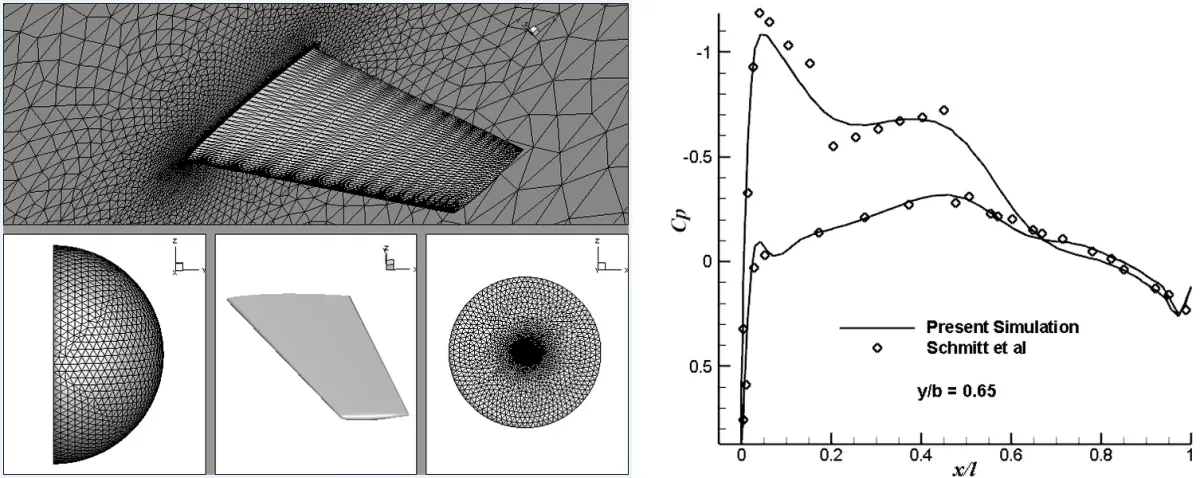
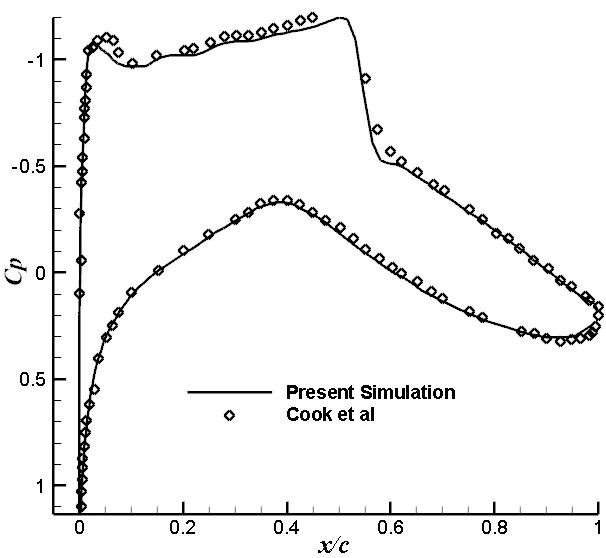
- Validated on two transonic benchmarks: the ONERA M6 wing at Mach 0.8395 against Schmitt et al, and the RAE 2822 aerofoil at Mach 0.729 against Cook et al.
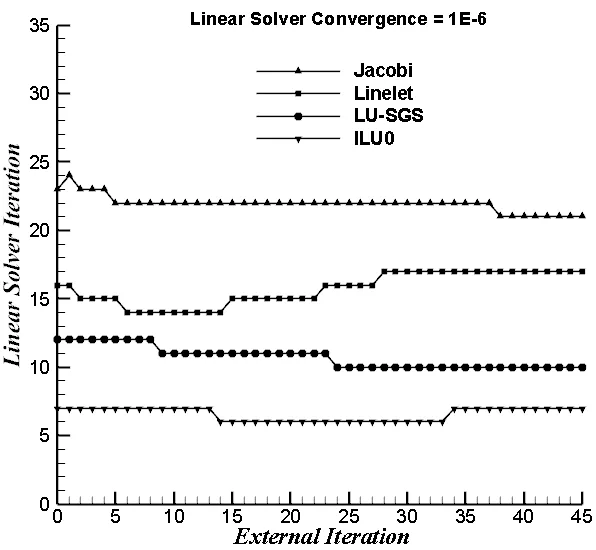
- Four preconditioners compared inside the linear solver: Jacobi, Linelet, LU-SGS and ILU0.
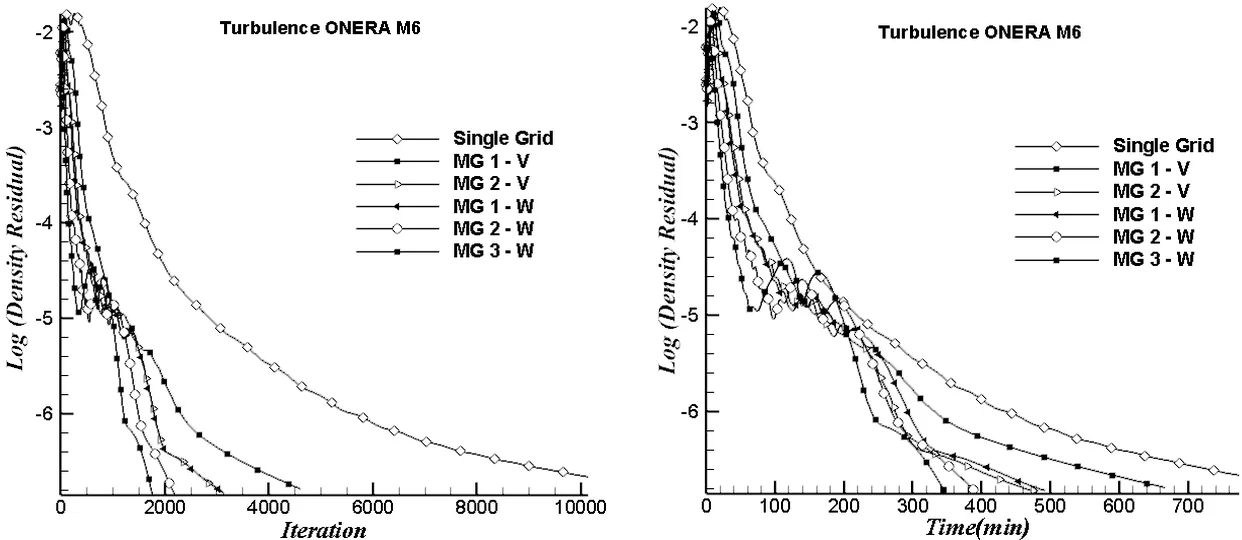
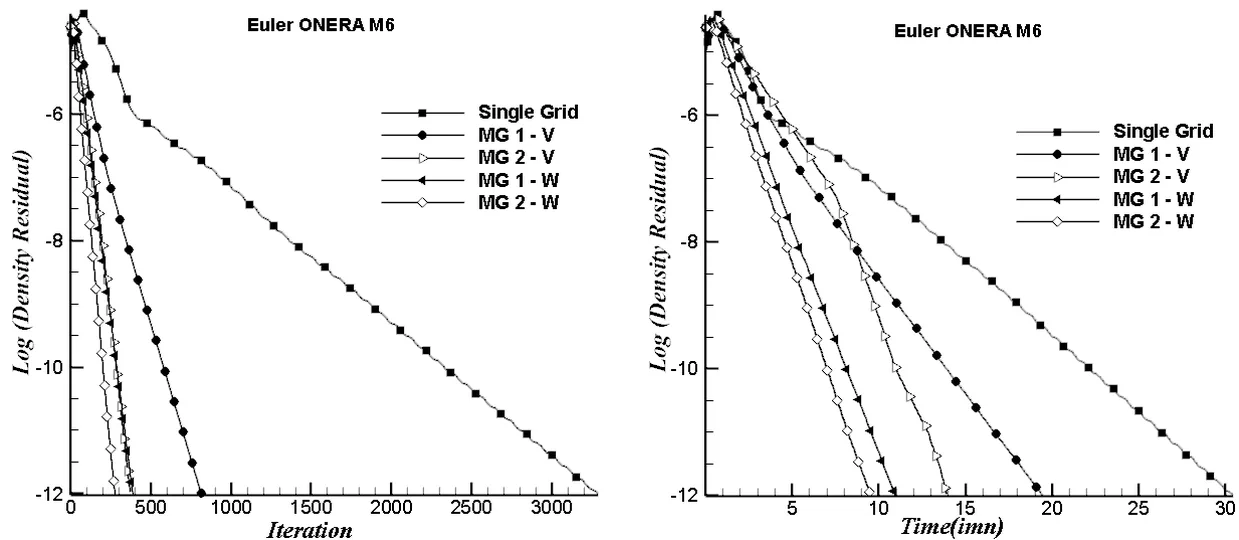
- Nonlinear multigrid with up to three coarse levels, using V and W cycles, run for turbulent, laminar and inviscid flow around the ONERA M6 wing.
Figures
Outcome
- LU-SGS was the best preconditioner to pair with multigrid, and the W cycle was the best way to move between grids for all three flow types.
- Turbulent flow: 81% fewer iterations and 51% less run time, with three coarse levels.
- Laminar flow: 80% fewer iterations and 34% less run time. Inviscid flow: 92% fewer iterations and 69% less run time, both with two coarse levels.
- The converged pressure distribution is identical with and without multigrid, so the speed-up costs no accuracy. Beyond three coarse levels, the coarsest grid is too poor to remove the low-frequency error, and convergence gets worse.
- Multigrid
- Preconditioning
- Compressible flow
- Solver development