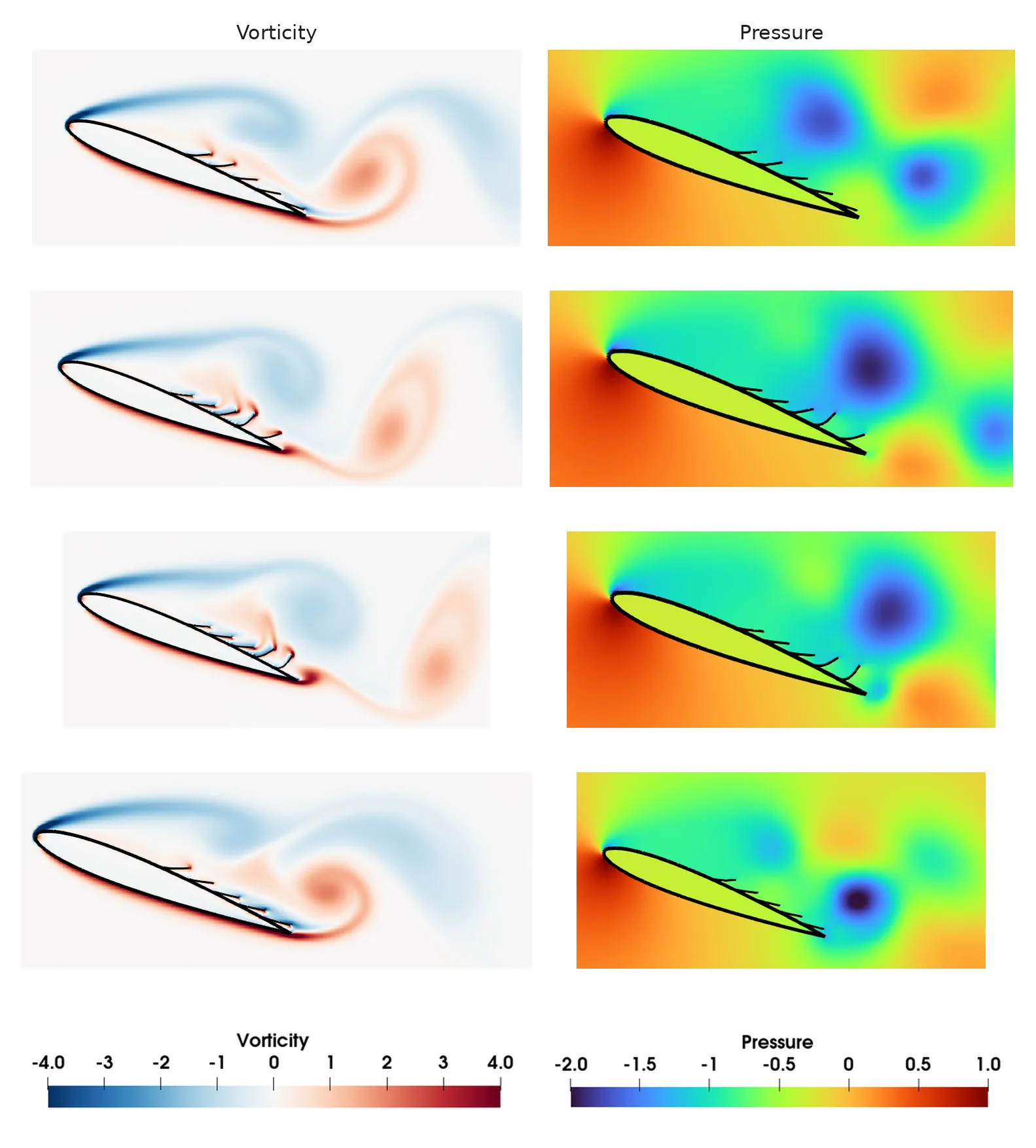
Vorticity field around the aerofoil and flaps. Own simulation.
Bio-inspired flaps on an aerofoil
Dr Mohammad Ghaffari · UNSW Sydney · 2020 to 2024 · Research
Context
Birds adapt the flow over their wings with feathers that lift, bend and realign as conditions change. The aerodynamic role of that behaviour is not well understood, partly because modelling very light, very flexible structures inside a turbulent flow is difficult.
My role
I was the CFD engineer building the coupled solver and running the study across the parameter space.
Approach
- Modelled feather-like flaps attached to an aerofoil as a fully coupled fluid structure interaction problem.
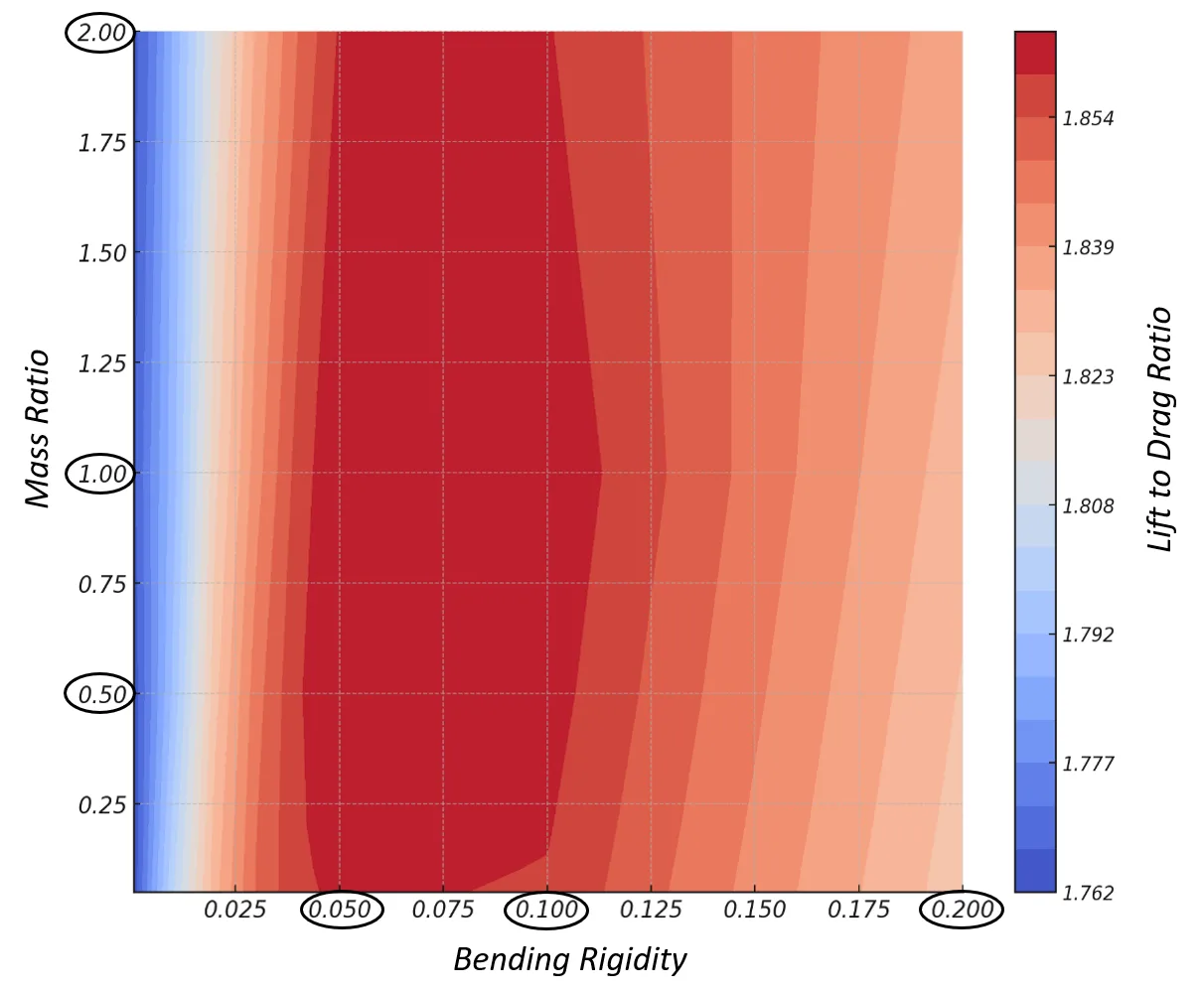
- Varied mass ratio, bending rigidity, flap geometry and the number of flaps across the parameter space.
- Resolved the flow with the lattice Boltzmann method and the structural response with finite elements, coupled through an immersed boundary method.
Figures
Outcome
The flaps improved the lift to drag ratio by up to 27.2 per cent compared with a clean aerofoil, through delayed flow separation, altered vortex shedding and stronger shear layer interaction.
- IB-LBM
- Fluid structure interaction
- Flexible structures
- Vortex dynamics